AIYS after 40
Reflections on the History of AIYS
The American Institute for Yemeni Studies (AIYS) celebrated its 40th anniversary in 2018. Founded in 1977, the first office in Ṣan‘ā' was opened in 1978 under the directorship of Dr. Jon Mandaville. During its 40 years AIYS has supported American, other foreign and Yemeni researchers with fellowships and assistance for research permission through its Yemeni counterpart, the Center for Research and Studies.
This page contains reflections and photographs from former AIYS officers, resident directors and fellows. We encourage anyone who has used the facilities of AIYS or benefited from assistance to send their reflections and photographs for inclusion, as AIYS goes forward to assist our colleagues in Yemen.
If you'd like to contribute to these reflections, please reach out to aiys.us@aiys.org
Delores Walters

Delores Walters in Wadi Dhabab, 1994
I first went to Yemen in the summer of 1981 on a FLAS (Foreign Language and Area Studies) Fellowship to study spoken Arabic, having minored in Modern Standard Newspaper Arabic at NYU. My Arabic language study was in preparation for a doctoral dissertation fellowship in cultural anthropology funded by SSRC and Fulbright between 1982-84. Steven Caton, who was director of the Peace Corps in Sanaa, headed the language-training program, which included several Yemeni teachers. Peace Corps residents in Sanaa that year included American, Dutch, British and German volunteers. Steve introduced me to Leigh Douglas who was resident director of AIYS at the time.
It was quite a shock to learn later that Leigh Douglas was one of three men, including two British citizens, killed in Beirut in 1986 in retaliation for the U.S. bombing of Libya.
Leigh had taken genuine interest in my research and was particularly helpful in insuring that Lee Maher, my partner at the time, would be able to accompany me when I returned to Yemen in 1982 to begin my field research. He had made the introductions at the Yemen Center for Research & Studies (YCRS) to begin the process of obtaining residency and research clearance. AIYS and the resident directors were chiefly responsible for connecting Americans to the Yemeni research center and were especially helpful in that regard. Once introduced, the staff and director of YCRS, Dr. Abdul Aziz al-Maqalih, (also a literary scholar and poet) were remarkably helpful, kind and attentive. Lealan Swanson became resident director of AIYS early during our stay. Occasionally, Lee filled in for Lealan when the latter was away for short periods.
AIYS provided a wonderful venue for meeting and networking with other researchers, Americans -- early “pioneers” in Yemen, including, Najwa Adra and Dan Varisco, Sheila Carapico, Jon Swanson, Shelagh Weir, Cynthia Myntti, Huda Seif, and Barbara Croken. Some of these fellow researchers helped prior to our arrival in the country or afterwards during our transition. Among the other foreign nationals I met were Ursula Dreibholz, Fr. Etienne Renaud and the French researchers such as Jean Lambert, all of whom were especially warm and welcoming.

Barbara Croken, Lee Maher and Delores Walters, 1982

Delores and Lee Maher, 1982
One of those supportive pioneers was Tomas Gerholm, a Swedish anthropologist who wrote one of the earliest analyses of Yemeni hierarchical society in the modern era -- Market, Mosque and Mafraj. His untimely death in 1995 was also a sad memory. As my work would similarly focus on social hierarchy, particularly at the bottom of Yemen’s intricate ranking system, Tomas and I spent many hours in the early days of my field research in discussion that proved extremely beneficial to my understanding of social relations. Yemeni sociologists we met initially -- Hamud al Oudi and particularly Abdo Ali Othman provided an invaluable understanding of Yemen’s social hierarchy from an essential and indispensable Yemeni perspective.
When I finally found a place to carry out my 18 month-long research, I remember the young lads who I encountered in the Suq ad Dhabab, just south of Taizz, being highly amused upon reading in my research permission letter that my work would focus on the akhdam, an outcaste, African-identified group who lived in separate enclaves in the region. I had already concluded that while I could have arranged daily visits to the akhdam shantytown in Sanaa without venturing farther afield, it was not the setting with multiple group interactions that I had envisioned. The shantytown had invariably been described as a heap of garbage making, resident participant-observation nearly impossible.

Tomas Gerholm and Lee Maher, 1982
In Yemen, I was almost never taken for an American. Invariably, Yemenis wherever we traveled in the country presumed that because I must be of African descent and spoke Arabic that precluded my being a citizen of the United States. They also perceived an appropriate age difference between my partner Lee and myself therefore presumed that she was my mother despite the fact that Lee was fair skinned and I, especially in the sunny environs of Yemen, was very brown. Another assumption was that I was the sister of the boxer Muhammad Ali as Yemeni experience of African Americans was limited to such notables as the internationally renowned boxer. Thus Yemenis constructed our identities on their own cultural terms and according to their exposure to others via television most often powered by village generators.
We were a known and protected entity in the village of Wadi Dhabab, and that continued after we relocated in the town of ‘Abs in the northern Tihama to complete our research agenda. The town, unlike the village, was more open and accessible to both ‘Absi and non-‘Absi residents. We attached ourselves to the clinic (mustashfa), which during the 1980s was operated by an international team of doctors and nurses, notably from Ethiopia and England. In that environment, we again achieved the status of protected and highly regarded guests among our Yemeni neighbors.
AIYS was a major support financially and logistically through several subsequent research trips to Yemen, between 1994-1998. In the 1990s, the clinic facility in ‘Abs, now the Maternal & Child Health Center, was run by the murshidat (literally health guides) who had been trained as midwives and as the primary care givers for mothers and children. Sudanese midwives were their teachers. My video, Murshidat: Female Primary Health Care Workers Transforming Society in Yemen (1999) focuses on these women. In addition to delivering babies and treating illnesses such as malaria, many of them routinely conducted home health visits in the market area (suq) where the social outcastes lived. These murshidat activists were thereby breaking down social barriers that would have rendered African-identified akhdam and formerly enslaved ‘abid outside the delivery of health services, despite the official abolition of such stigmatized and marginalized status.

Screening of Murshidat at AIYS, 1998
Among those who lent their expertise and support in the production of the video were Najwa Adra, Raja’a al Musabi, Marina deRegt, Noha Sadek, AIYS resident director, and Amat al Alim as Suswa, then deputy secretary to the Minister of Information who facilitated my obtaining archival footage of the 1962 revolution in what was then North Yemen that I used in the video. Other productive encounters at AIYS during my postdoctoral research were Janine Clark, Lucine Taminian, Ria Ellis (executive director of AIYS), Barbara Michael and Husnia al Qadri.
The screening debut of Murshidat took place in the AIYS mufraj in December 1998 with an audience that included AIYS hostel residents who were members of an ICD (International Cooperation for Development) team from London, Namibia, Somalia and Zimbabwe. Others such as Basma al Qubayti, director of a non-profit training facility for girls in Sana’a, had assisted in research pertaining to the murshidat. Similarly, the murshidat, and their clients -- mothers and some fathers – also viewed the completed video in the ‘Abs clinic in December 1998. Ra’ufa Hassan, one of the first female journalists in Yemen, showed it to her Women’s Studies class at Sanaa University. It was also presented to the American Embassy in Yemen’s capital. The Murshidat video was well received and can be seen on YouTube. Steven Caton, professor and former director of the Center for Middle East Studies at Harvard, facilitated the acquisition of the video for one of the university’s libraries.
AIYS has promoted the work of researchers in Yemen, providing financial, logistical and residential support (through its hostel) for four decades. In my experience, visiting scholars form a community thereby creating an invaluable resource for scholarly endeavors. It is crucial that AIYS continues to provide such a haven for researchers as their work will especially matter in the recovering environment beyond the current crisis.
Noha Sadek
Since I landed in Sanaa for the first time on a brisk early morning with Ed Keall and four other members of the Canadian Mission of the Royal Ontario Museum in Zabīd, Yemen became the main focus of my research and AIYS played an important role in providing a reassuring base, administrative support as well as contacts with fellow researchers. Located near the Tourism office on Taḥrīr Square, AIYS in 1982 was a small house whose director, Leigh Douglas, gave us spartan but reassuring headquarters. Gazing then at AIYS’s colourful qamariyas, I had little inkling that I would return to Yemen three years later for my Ph.D. thesis research on Rasulid architecture.

Noha Sadek in AIYS office in Bayt al-Sammān,
December 1997
Thus, I deemed myself lucky to have been awarded the AIYS doctoral fellowship for 1985-86. I shrugged off objections voiced over the fellowship being given to a Canadian, and I spent most of my six-month research period in Ta‘izz studying its magnificent Rasulid monuments. By then, AIYS had moved to a house on 26 September street but I did not reside there during my trips to Sanaa as I lived in Selma Al-Radi’s house in ḥārat al-ʿAjamī, an alley named after the family that owned most of the buildings in it, and whose major landmark was the French Centre for Yemeni Studies (CFEY). I subsequently returned to Yemen to continue work on Zabīd with the CAMROM, and with the help of local historian ʿAbd al-Raḥmān al-Ḥaḍramī I succeeded in mapping the town’s 86 mosques. Our common interest in Yemeni architecture made Selma and I decide to embark on a survey of Yemen’s painted mosques, for which we received an AIYS grant in 1993 that allowed us to hire a car and a driver that made travel to remote mountainous regions, where several of these incredible buildings were located, a lot easier.

Noha Sadek on the mosque trail in Zabid
(Photo by Ed Keall)

Noha Sadek with Qadi Ismāʿīl al-Akwaʿ in Zabīd, 1988 (Photo by Ed Keall)
Once more, my non-US citizen status was overlooked when I returned to Sanaa in January 1995 as Resident Director. By then, AIYS was located in the imposing Bayt al-Aʿraj house in Ṣāfīyah, but unfortunately, the building’s great need for repair and a steep rent hike forced us to move AIYS to yet another location. The house of former waqf minister, ʿAlī al-Sammān, on al-Bawnīyah Street provided another temporary base until it was relocated afterwards to the nearby Bayt Hāshim.
Following its unification in 1990, Yemen attracted a new generation of scholars with outstanding research projects in different regions in addition to Sanaa, in the Tihama, Yāfiʿ, Ḥaḍramawt, etc. The growth of AIYS’s erstwhile shoestring funding through different US bodies (largely USIA & CAORC) meant an increase in the number of fellowship grants to Americans as well as to Yemeni scholars. Liaison with Yemeni institutions (primarily GOAMM and YCRS), overseeing the AIYS translation series, holding lectures by resident and visiting scholars, coordinating fellowship applications for Yemeni researchers, co-preparing the setup of the Arabic language training with YLC, answering queries, the running of the hostel and the library: these were some of the many tasks that occupied my three-year tenure. Moreover, AIYS signed in 1995 an agreement with the government of the Netherlands to administer Dutch funding allotted for the restoration of the 16th century madrasa al-ʿĀmirīyah in Radā‘. Undertaken by the tireless Selma Al-Radi, this colossal project received an Aga Khan award in 2007.
I must add that it was also thrilling to witness the introduction of internet in Yemen in 1996, which needless to say, made communications more rapid despite its early glitches. I will conclude these random thoughts by stating that my administrative tasks, and no doubt those of my successors, were considerably facilitated by the great skills and good humour of Ria Ellis who was appointed Executive Director in the US in the same year I became Resident Director in Sanaa.

Street flooded after heavy rain, Mac Gibson in front of AIYS Bayt al-Aʿraj, Spring 1995, (photo by
Ria Ellis)

AIYS Bayt al- Sammān 1995, main building with office, mafraj and hostel, library in separate annex
(photo by Noha Sadek)
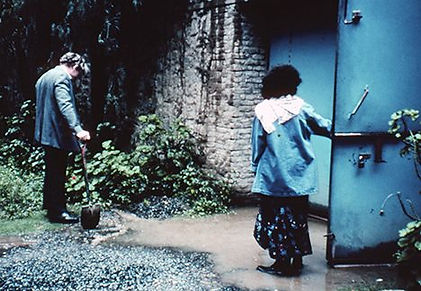
Mac Gibson and Noha Sadek trying to figure out how to divert the water in front of AIYS, Bayt al-Aʿraj, Spring 1995 (photo by Ria Ellis)

Lucine Taminian giving a lecture in AIYS mafraj in Bayt al- Sammān, March 1996 (photo by Ria Ellis)
Steve Caton

Steve Caton (right) and Najwa Adra in al-Ahjur, February, 1979
In its early days, AIYS seemed to operate on a shoe-string budget. (Perhaps its officers would maintain that it still does so today.) And so its first resident director Jon Mandaville had to be entrepreneurial to make ends meet, and one of his money-making schemes was to sell t-shirts that had an image and “American Institute for Yemeni Studies” printed on the front. I believe this was sometime in 1980. I bought one. I only could afford to buy one because I too had a hard time making ends meet on my meager fellowship. I imagine my student colleagues in AIYS were not much better off financially, and so I wonder how big a money-maker the t-shirts were in the end.
I’ve kept t-shirts over the years which I associate with different places I’ve been to, and this has amounted to quite a collection. When I rummage through my drawers to retrieve one, I pick a t-shirt that seems to fit my mood on that day. Even after they’ve gotten torn or faded, I continue to wear them, until I reluctantly consign their tatters to the scrap heap, where they have second lives as cleaning rags.

But there are some t-shirts I don’t wear very often, precisely because they are irreplaceable or one of a kind, and my t-shirt from the early days of AIYS fit this description. I wore it while I was still doing fieldwork in Yemen, and afterwards again when I grew nostalgic for those days. But around ten years ago, I decided not to wear it at all, lest it suffer the fate of my other worn-out, thread-bare t-shirts, so I “retired” it to the bottom of the drawer and hardly saw it again. In time, I forgot it was even there.
Until Dan Varisco put out the call for memories of AIYS on the anniversary of its founding. I asked myself whether that t-shirt from so long ago was still in my possession.
I was relieved that it was, and not the worse for wear either because of the precautions I had taken with it. It is a Hanes cotton-polyester mix made in the USA, size XL46-48. (Why so large, I wonder?) It’s gray (I don’t recall whether this was the only color it came in or just the one I chose because of its elegance). On its front is the image Jon had chosen to symbolize AIYS, a qamariyyah or stained glass Yemeni window, ringed at the top with a half-inch black line and edged at the bottom with a slightly narrower one. The window design is white, simulating the white-plaster of the original, though the panes of glass are not colored but gray, no doubt to keep the cost low. Underneath the window, on the side where the heart is, is clearly written in Arabic the title that can also be found on the left, American Institute for Yemeni Studies.
The choice of window design leaves me a bit puzzled now. The Star of David is on prominent display in the middle. As we all know, this is not an uncommon sight in Yemeni windows, and yet to be displayed on a t-shirt promoting an American research institute: did this not seem politically provocative? Or were these rhetorically more “innocent” times? The white on the window is also peeling off (it’s an appliqué) which is no doubt another reason I stopped wearing it. Every time I washed it, the appliqué was more degraded until the window looked to be in ruins.
I don’t want to make too much of the metaphor (or perhaps the synecdoche), but that t-shirt stands in for AIYS more than I could have imagined when I first bought it. A little worn. A little faded. Still provocative (perhaps more so than before). Retired to the bottom for safe-keeping until the day when it can function at full-strength again. Certainly not ready for the scrap heap. Its name emblazoned over the heart.
Steven C. Caton is Professor of Anthropology at Harvard University. His first book was Peaks of Yemen I Summon: Poetry as Cultural Practice in a North Yemeni Tribe (1993) and he has also written Yemen Chronicle: An Anthropology of War and Mediation (2006).
Note: Charles Schmitz has noted that the star on the AIYS t-shirt is actually 5-sided and not the star of David.
Nathalie Peutz
It was during my first summer in Yemen as a novice Arabic student at the Yemen Language Center (YLC) in 1999 that I discovered the American Institute for Yemeni Studies and all that it had to offer. Conversations with prominent scholars based at or passing through YLC and a fortuitous meeting with AIYS resident director Marta Colburn led to my applying for a NMERTA/AIYS language fellowship for the following summer and, over time, to a fulfilling career that I owe entirely to Yemen and the repeated forms of AIYS support that helped launch it. Looking back, it is difficult for me to imagine how I would have navigated my anthropological research in Yemen or my academic career without the financial, material, logistical, and social support in addition to the physical base that AIYS provided.

Nathalie Peutz in Homhil, Soqotra (2003, AIYS fellowship)

Justin Stearns on the roof of the AIYS hostel on al-Bawniya Street (2003)
In 2000, this AIYS support enabled me to return to Yemen for further Arabic study. Living in the delightful home on al-Bawniya street, my partner Justin Stearns and I enjoyed numerous lively discussions with other resident scholars in its charming mafraj and kitchen spaces. It was here, in 2000 and the years following, that we first met several of our current and former institutional colleagues: Marion Katz (New York University), Maurice Pomerantz (NYU Abu Dhabi), and Samuel Liebhaber (Middlebury College). It was also through the AIYS that I met Nancy Um, who kindly invited me along on a research trip to al-Hudaydah and al-Mokha. This experience, and a subsequent cattle boat crossing from al-Mokha to Berbere and from Djibouti back to Mokha, deepened my interests in Yemen’s Horn of Africa connections and motivated my initial research on Somali refugees and deported migrants in al-Hudaydah (January 2002, spring 2003) and in Somaliland (summer 2002, fall 2003). Little could I have guessed then that I would end up returning to Somaliland and Djibouti in 2016, this time to begin research with Yemeni refugees in the Horn of Africa (see link), instead of with Somali refugees in Yemen.
In 2003, an AIYS grant for preliminary research afforded me a good six months in Yemen to pursue potential dissertation topics. Whether it is because this was to be the longest period I have spent in Sanaa, or because of the tense build-up to the Iraq War, my memories of this period are particularly entwined with memories of the AIYS hostel. A week before our departure to Yemen, Justin Stearns and I were in New York City protesting the imminent invasion. A few weeks later, in Sanaa, foreign researchers were warned to stay away from protests and to avoid traveling around Yemen. What I remember most, apart from working in the AIYS’s extraordinary library, is the many hours we spent watching media coverage of the invasion, often with Selma al-Radi. Eventually, Justin and I “escaped” to Soqotra, from where we continued to watch the invasion and, then, the Fall of Baghdad. One day, however, we splurged on a half-day car rental and driver who took us to a protected area called Homhil. Again, little did I know then that I would end up living in Homhil just over a year later (2004–2005) and that I would continue to research and write about conservation, development, and heritage in Soqotra for over a decade to come. Generously funded by Fulbright-Hayes and a follow-up research grant from the AIYS (2007), and greatly facilitated by the AIYS’s resident director Chris Edens, this research resulted in my dissertation and my forthcoming book, Islands of Heritage: Conservation and Transformation in Yemen (Stanford University Press, 2018).

Justin Stearns outside my solar-powered house in Homhil, Soqotra (2004)

Taking fieldnotes inside my house in Homhil (photograph by J. Stearns, 2004)
After having shifted my research focus to Soqotra, I began spending less time in Sanaa and, consequently, less time at the AIYS hostel. Nevertheless, Chris and his successor, Steven Steinbeiser, continued to facilitate my research as well as to offer valuable guidance and advice. And, each time I visited Sanaa, the AIYS hostel—a vital sanctuary from the rigors of fieldwork—felt like home. It was here that I also benefitted from conversations with David Buchman, Steve Caton, Joy McCorriston, Miranda Morris, Carolyn Han, Lamya Khalidi, Michelle Lamprakos, Stacey Philbrick-Yadav, Sarah Phillips, Marjorie Ransom, Dan Varisco—to name just a few of the scholars I first met on its grounds—many of whom I have had the great privilege of working with in later years. The social connections forged in and through the AIYS hostel have been as indispensable as have been these academic networks. When I received the shocking news one night in Sanaa that my father had passed away, I immediately headed over to the AIYS hostel; this is where I knew to find logistical and emotional support.

Returning to Soqotra with my son (2007, AIYS fellowship)
Due to the ongoing tragedy of the war in Yemen, I now conduct research in the Horn of Africa instead. Many of the Yemeni refugees I interview these days in the Markazi camp in Djibouti tell me that they have decided against ever returning to Yemen, that Yemen is “khalas.” I sincerely hope that this is not the case—that there will be a welcome return for them someday in a Yemen that is peaceful, and healing. Until then, I take some small comfort in knowing that the AIYS is far from “khalas”—that it continues to open its doors to Yemeni scholars and to support essential research in and on Yemen. The AIYS has provided many invaluable services for so many scholars. I am deeply grateful to the institution and all of its hardworking directors, presidents, and staff for all the opportunities the AIYS has given me.
Nathalie Peutz is Program Head of Arab Crossroads Studies and Assistant Professor of Anthropology in the Arab Crossroads Studies Program at New York University Abu Dhabi

Jon Swanson
When I arrived in Yemen with my wife and two children in January of 1974, there were few researchers in the country save perhaps for Tomas Gerholm in Manakha. On advice from Yemeni friends in the US, we settled in Taiz where we remained until the end of July 1975. In those days there was no AIYS so we were left to sort things out on our own. About a year after we returned to Detroit I got a call from Mac Gibson about a meeting at the University of Chicago to set up a research facility in Yemen. I thought this a fine idea and took the train to Chicago where I met with Mac, the late Manfred (Kurt) Wenner, Marvin Zonis, and perhaps one or two others whose names I can’t recollect. We ended up meeting two or three times.

View of Taiz
Under Mac’s leadership AIYS began to set up bylaws based on the bylaws of other research groups like the American Research Center in Egypt. It was orginally proposed that we might call AIYS the “American Research Center in Yemen” but this was rejected and we eventually settled on the American Institute for Yemeni Studies. I suggested that we include a rule in the bylaws barring anyone engaged on intelligence gathering from the institute on the grounds that researchers and research would be jeopardized if we were in any way perceived as government agents. This amendment found support and was adopted.
When I returned to Yemen in 1979, AIYS was in full swing with Jon Mandaville as the local director. He and his family were welcoming and very supportive. Like many researchers I stayed there briefly before I found an apartment. Other researchers there at the time included Barbara Croken, Tom Stevenson, Susan Dorsky, and Steve Caton. Subsequently Leigh Douglas became director. Leigh later taught at the American University of Beirut where he was tragically kidnapped and later assassinated by a faction of Hizballah after Reagan ordered airstrikes on Libya which killed members of Muammar Qadafis family.
From 1981-83 my then wife, Lealan Swanson, served as director of AIYS and she is best able to relate that chapter of the AIYS saga. One memory of that period which will probably not make her part of the story is that while my daughter and walking in gulleys west of Sanaa near the international school my daughter pointed out a stone hand axe. I subsequently collected a number of these and left them at AIYS. They certainly confirmed the ancient human occupation of the Sanaa plateau and the possibility of productive archaeological research in the area.
Jon Swanson was the first American anthropologist to do research in Yemen in the early 1970s. For an article by Jon on Yemeni emigration, click here.

Michel Zurowski

Michel at Sabanco place (Old Sanaa, Harat at-Talh)
In October 2010, I arrived Sanaa for a 10 months scholarship to practice Arabic language and get experience of Arabic culture. It was a basic scholarship set on agreement between the Polish and Yemeni governments. From the Polish side it has been used mostly by students of Arabic language studies, however Yemen was not a popular destination. That year only I and one girl came (and there were 5 places).
The scholarship was a great chance to gather material for my B.A. thesis on an introduction to Yemeni dialects. Because of that, I reached out to AIYS about its facilities in Sanaa. I got some directions from Faraj, but getting to AIYS was quite challenging as it was in an uncharacteristic house, located in a small alley near the Republican Hospital in al-Qa’a Street. There I met Faraj and Stephen (AIYS director at the time).


Date seller near Bab al-Yaman
Suq al-‘Arj (Donkey Market)
I have spent some long hours in AIYS library going through dialectological books and dictionaries. It contained everything that was written on Yemeni dialects. It was a very enjoyable time, but also crucial for my B.A. thesis. Unfortunately, at my home University of Warsaw, there were not any positions for dialectology.
My research coincided with turmoil times that shadowed the whole Arab world. My stay was cut short and I left Yemen on 3rd June, 2011, the same day bomb exploded in Presidential Palace and was supposed to kill Ali Abdullah Salih.

All my experiences with AIYS were great and fundamental for my academic success. Footnote 1 in my thesis states: “I got access to books in greatly supplied library of American Institute for Yemeni Studies, which contains, not only positions on Yemeni dialects, but also on South Arabic languages. Not to mention other subject areas”.
Beginning of Arab Spring in Yemen –demonstration next to Sanaa University
Ian Tattersall
AMNH PALEONTOLOGICAL SURVEYS IN YEMEN, 1988 AND 1991
When a paleontologist becomes interested in the fossil possibilities offered by a remote and unknown country, what does he or she do? In the case of a group based at the American Museum of Natural History in New York City, and intrigued by the paleontological potential they saw in the United States Geological Survey map of the Yemen Arab Republic, the answer was to turn to the American Institute of Yemeni Studies. Directly across the Red Sea from Ethiopia and Eritrea, northern Yemen is in many ways a geological mirror-image of those fossil-rich countries; and although it sadly lacks any equivalent of the famous Afar Triangle in which many of Ethiopia’s and all of Eritrea’s most famous fossils have been found, our preliminary review of the USGS map suggested that the largely unexplored fossil potential of Yemen was well worth looking into.

The Sana'a that greeted us in May, 1988
Accordingly, in 1987 Ian Tattersall, a curator in the AMNH’s Department of Anthropology, contacted Jon Mandaville, then the AIYS President. Jon was enormously helpful and encouraging, and put us in touch with Jeff Meissner, then Resident Director of AIYS in Sana’a. AIYS was already well established as the principal English-speaking center of research in history, archaeology and the humanities in Sana’a, but it had never welcomed geologists before. Jeff had the excellent idea of not putting us in touch with the Antiquities authorities with whom he customarily dealt, but instead with the Ministry of Oil and Mineral Resources of the Yemen Arab Republic (YAR). This was a brilliant decision, since the MOMR proved not only to be very supportive of our paleontological objectives, but also had the authority to issue us permits to prospect the entire Yemen Arab Republic for fossils.
With funding from the National Geographic Society in hand, the AIYS Center in Sanaa as a base, and preliminary research permission from the MOMR granted, an AMNH team travelled to Sanaa at the end of May, 1988, and remained until the middle of July. The group consisted of Ian Tattersall, Mike Novacek, then a Curator in the AMNH’s Department of Vertebrate Paleontology, now AMNH Provost, and Maurice Grolier, a geologist who had worked on the USGS geological map of Yemen – and who had also chosen the spot for the first manned lunar landing. Jeff Meissner joined us for some of our explorations, and we also benefited greatly from the advice of Dr Hamel El-Nakhal of the Geology Department of the University of Sana’a. AIYS provided the field vehicle as well as an essential center of operations, and we remain particularly grateful to His Excellency Ali Gabr Alawi, Deputy Minister of Oil and Mineral Resources, for his understanding of and support for our goals.

Maurice Grolier (l) and Ian Tattersall on the roof of the AIYS Sanaa building, 1988
During six weeks of exploration our group covered some 4,000 miles on mostly very poor or nonexistent roads and examined over 100 potential fossil localities in almost all parts of the YAR. Sadly, the results were less bountiful than we might have wished. Some traces of fish bone were collected from freshwater Oligocene deposits interbedded in the Yemen Volcanics at Jabal Matran, south of Tai’zz, and traces of fossil wood were found at this locality and in interbeds elsewhere, notably near the summit of Jabal an Nabi Shu’ayb, the highest point in the Arabian Peninsula.
Only at one locality, a quarry near the village of Khulaqah below the base of the late Cretaceous Tawilah Formation, did we collect significant vertebrate fossils: well-preserved lacustrine fish of ichthyodectiform affinity that were ultimately identified by our AMNH colleague John Maisey.
Although disappointingly unproductive of fossils, our 1988 explorations were not uneventful. Consider this extract from Mike Novacek’s engaging memoir, Time Traveler, describing a night-time event in the far north near Jabal Marah early in our wanderings:
“Meester Ian, Meester Mike, these are veeery bad men, they will keel us,” was Ali’s warning call. Ali was our sentry, our Yemeni escort from the Ministry of Oil and Mineral Resources … then I saw several heavily armed men jump out of the jeep and come stalking toward us. One surly fellow pointed his Soviet-built rifle at my head and started speaking … Jeff Meissner composed a translation of the fellow’s message … “This officer commands a patrol of the North Yemen border militia. He says that this is a very dangerous area – full of anarchists, gunrunners, smugglers, and hijackers … he forcefully ‘invites’ us to sleep at his army checkpoint.”

Prospecting in the outcrops at Jabal Matran
We duly proceeded to the checkpoint, and once there the commander attempted to relieve us of our passports while his henchmen took the keys to the AIYS Land Cruiser. Things were looking very ugly. The ensuing night of fitful sleep was, fortunately, followed by an unanticipated sudden liberation – possibly due to our letter from the MOMR having been verified – with an admonition never to return.

Prospecting (in vain) in the north
We might have learned from this incident, but as time passed unrewarded by fossils we became a little desperate. Finally, it appeared that our only good geological hopes lay in the Wadi al-Jawf, the “empty quarter” in the east that lay beyond government control. Jeff was dubious about risking the AIYS vehicle in this lawless territory, but eventually conceded to our pleas on the wise condition (for us) that he accompany us once more.
The Jawf turned out to be an attractive region where people lived and worked in forced-mud buildings that appeared as if from the beginning of time.
Within them the rooms were unadorned by Presidential portraits, and among them strolled bare-headed women in colorful knee-length dresses. The local people were definitely calling the shots here, and to a superficial observer the scene had a laid-back air about it. But all was not exactly easygoing. Cut back to Time Traveler, describing an episode that began as we were fruitlessly and despondently looking for vertebrate fossils in a road cut, and a cloud of dust appeared on the horizon. The dust soon resolved into a convoy of Land Cruisers, bristling with heavily-armed men, that promptly surrounded us:
The man in the driver’s seat got out and walked purposefully toward me. He stopped within inches of my face and gave me a grimace and an interminable study.
“Where are you from?” he asked in perfect English, to my amazement.
“New York,” I said.
“Pleased to meet you. I’m from Detroit.”
The man explained that he had labored on the production lines of General Motors, made enough money, and had then returned to the Jawf to be the feudal lieutenant of the local sheikh. Somewhat ominously he continued, “the sheikh wishes to invite you to tea.”
Knowing the reputation of the Jawf for kidnappings and disappearances, our hearts sank into our boots. But we knew this was not an offer we could refuse. We joined the convoy and drove off into the desert, where our ultimately destination turned out to be an isolated but elegant building that was still under construction.
As we entered the newly painted mafraj, the Land Cruiser crew threw their weapons on to a large and growing pile in the middle of the floor and settled on cushions along the side. The sheikh began to adjudicate disputes among his subjects, and large quantities of qat were passed around. We were evidently in for the long chew, although we had no way of knowing how permanent the sheikh’s hospitality was going to be. In the end, the occasion was a convivial one, and the young sheikh proved to be highly personable, casually remarking to us (as translated by Jeff) that his family had sacked Sanaa twice, most recently in 1948.

Mansion in the Wadi Jawf
As the evening light started to fade and we were beginning to wonder what lay ahead for us, we were graciously ushered on our way, with an invitation to return any time under the sheikh’s protection. Never have I so bitterly regretted not having found a good fossil site. Even the sheikh appeared a little wistful, saying, as Mike recalls in his memoir: “I’m sorry we have too much oil and gold and not enough bones.”
This encounter ended the last major foray of our first exploration of Yemen, and to our great disappointment what we had found had not justified coming back. But a couple of years later we learned through Dr El-Nakhal that the impressions of fossil frogs had been found at Ar Rhyashia, near Rada’, and we were also informed by Scott Rolston, who took over as AIYS Sanaa Resident Director in 1989, that he had discovered part of a dinosaur skeleton near the main road north from Sanaa, just south of Sa’da. What is more, northern and southern Yemen had been reunified in the interim, making it possible for the first time to prospect in what had been the People’s Democratic Republic of Yemen. It thus seemed worthwhile to try again, and the National Geographic Society bravely and imaginatively agreed to fund the attempt.
As we entered the newly painted mafraj, the Land Cruiser crew threw their weapons on to a large and growing pile in the middle of the floor and settled on cushions along the side. The sheikh began to adjudicate disputes among his subjects, and large quantities of qat were passed around. We were evidently in for the long chew, although we had no way of knowing how permanent the sheikh’s hospitality was going to be.
In the end, the occasion was a convivial one, and the young sheikh proved to be highly personable, casually remarking to us (as translated by Jeff) that his family had sacked Sanaa twice, most recently in 1948. As the evening light started to fade and we were beginning to wonder what lay ahead for us, we were graciously ushered on our way, with an invitation to return any time under the sheikh’s protection. Never have I so bitterly regretted not having found a good fossil site. Even the sheikh appeared a little wistful, saying, as Mike recalls in his memoir: “I’m sorry we have too much oil and gold and not enough bones.”
This encounter ended the last major foray of our first exploration of Yemen, and to our great disappointment what we had found had not justified coming back. But a couple of years later we learned through Dr El-Nakhal that the impressions of fossil frogs had been found at Ar Rhyashia, near Rada’, and we were also informed by Scott Rolston, who took over as AIYS Sanaa Resident Director in 1989, that he had discovered part of a dinosaur skeleton near the main road north from Sanaa, just south of Sa’da. What is more, northern and southern Yemen had been reunified in the interim, making it possible for the first time to prospect in what had been the People’s Democratic Republic of Yemen. It thus seemed worthwhile to try again, and the National Geographic Society bravely and imaginatively agreed to fund the attempt.
Accordingly, and again with the indispensable help of the AIYS and authorization from MOMR, a second field season in the newly unified Republic of Yemen was organized in the fall of 1991. Mike Novacek and Maurice Grolier being unavailable this time around, the field team consisted, in addition to the AMNH’s Ian Tattersall, of the vertebrate paleontologists James Clark of George Washington University, and Peter Whybrow of the British Museum (Natural History) in London.

James Clark and Yemeni colleagues on the frog-bearing outcrop at Ar Rhyashiya.

Slab from Ar Rhyashiya with fossil frog skeleton of the species Xenopus arabiensis.

Part of the slab containing the thalattosuchian crocodilian from Zulma Ba-Thalab.
Our attempts to relocate Scott Rolston’s dinosaur site were not rewarded with success, but despite some stressful circumstances (see below) our visit to Ar Rhyashiaya led to the collection of numerous remarkably well-preserved fossil frog skeleton impressions of probably late Oligocene age. Amy Henrici of the Carnegie Museum in Pittsburgh and Ana Maria Baez of the University of Buenos Aires, subsequently described these skeletons as members of a new species of the genus Xenopus, X. arabiensis, and as the first occurrence of the genus in Arabia, subsequent to which the genus had become extinct on the peninsula.
Two areas in southern Yemen were also identified as promising. The first of these was at Zulma Ba-Thalab, north of the road between Aden and Mukallah (see map), where we found a partial skeleton of a late Jurassic teleosaurid thalattosuchian crocodile. Estimated at about 160 million years old, this was the oldest vertebrate fossil yet known from Arabia. Unfortunately, this fossil was found in a slab that had fallen from high on a tall cliff face, so the deposits concerned could not be prospected at the time.
The second promising area was a series of Paleocene localities in the Habshiyah Formation that were exposed in a series of depressions lying perpendicular to the shoreline in the Hadhramawt and Shabwa Governorates, both to the east and to the west of Mukallah. Vertebrate fossils recovered included various fish elements, some dugong ribs and a scapula, and a cetacean rib, and were accompanied by the first fossil flora known from southern Yemen. This flora included internal casts of a magnolid fruit cf. Anona, and fruits tentatively identified as belonging to the cucumber and waterlily families, plus abundant fossil wood. Together, the plant, vertebrate and invertebrate fossils discovered suggest that the facies of the Habshiyah Formation involved was deposited in a near-shore marine environment that interfaced with an onshore tropical rainforest via a marshy and lagoonal shoreline. This setting resembles that inferred for mammal teeth recovered from the late Eocene of southwestern Oman, and is also equivalent in both time and paleoecology to the renowned Eocene-Oligocene Fayum fauna and flora of Egypt.

Localities visited during second field season, 1991
Jim Clark has kindly provided the following personal account of our prospections during the 1991 expedition:
I had the great pleasure of traveling to Yemen with Ian Tattersall and Peter Whybrow from September 29 to October 19, 1991, in search of fossil vertebrates, a trip recounted in Peter's chapter in the book he edited, Travels with the Fossil Hunters. The north and south had only recently been united, and Ian was taking the opportunity to search for fossil human remains, hoping that fossil beds similar to those in Ethiopia that produced “Lucy” were present somewhere in the country.
Peter, from the Natural History Museum in London, was involved because he had found primate fossils in Saudi Arabia, and I was a "hired gun" fossil hunter who usually collected dinosaurs; Mike Novacek had recommended me to Ian after our work together in Mongolia earlier that year, when Mike could not make what would have been his second trip to Yemen.
We were hosted in Saana by the AIYS, which I remember being in a beautiful old building from which my jet lag allowed me to view sunrise over the city. Scott Rolston of the AIYS had found some fossils of what he thought were dinosaurs in the 1980s, and one of our trips was an attempt to try to find his locality. Unfortunately, either his notes or the kilometer signage along the highway were faulty, so we failed to find his site. We were more fortunate in collecting fossil frogs from a locality south of Sanaa, although as Peter describes in his chapter we were less fortunate in being interrogated by local people and essentially held at gunpoint until we paid them a fee for collecting the fossils.
We continued on to the south but never found the fossil humans Ian was hoping for, although we did find some bones of a fossil crocodilian that at that time was the oldest terrestrial vertebrate fossil from Arabia. We had a wonderful stop in Aden which delighted Ian, who grew up in Uganda and was transfixed by the charms of the decayed remnants of the British empire.
I have many memories of the trip – the amazingly reckless driving, the ubiquity of qat and AK47s, our valiant but ultimately futile attempt to find alcohol to drink and acetone to mix our glue in, the great hospitality at the AIYS without which we would have been unable to work, the amazing architecture everywhere we looked, and the beautiful countryside.
I wish the AIYS all the best on its 40th anniversary, it was there for us when we needed it.
Our prospections along the shoreline of southern Yemen indicated that the onshore and near-shore Tertiary deposits became thicker and better-exposed as one moved northeast toward the frontier with Oman; and indeed, in Oman itself similar deposits have yielded vertebrate fossils that are comparable with those in Egypt’s legendary Eocene-Oligocene Fayum deposits. On this basis, we predict that the best prospects Yemen offers for significant Tertiary vertebrate fossil finds lie in the area between Ash Shihr and the Omani border (see map). This is an extremely remote area that we were not equipped to explore in 1991, but that clearly merits future prospection when conditions permit.
We hope that our various accounts make clear how rewarding personally all the participants in the two AMNH expeditions to Yemen found the experience, even though the scientific results were not what one might ideally have wished.

Instructions to guests in our Aden hotel
Our prospections were made possible only through the active support and participation of the AIYS, and its active intercession on our behalf with the Yemeni authorities. AIYS is a nimble organization, able to react rapidly to circumstances as they arise, and able spontaneously to take an imaginative chance, as Jeff Meissner certainly did on more than one occasion. We are deeply grateful to AIYS, and we cannot better conclude this short account by repeating Jim Clark’s words, just quoted:
[We] wish the AIYS all the best on its 40th anniversary, it was there for us when we needed it.
Bibliography
-
Grolier, Maurice J. 1988. Geological results of the American Museum of Natural History-National Geographic Society Expedition to the Yemen Arab Republic May 30-June 14, 1988. In: Report on a Preliminary Survey of the Yemen Arab Republic. American Museum of Natural History, submitted to National Geographic Society.
-
Henrici, Amy C. and Ana Maria Baez. First occurrence of Xenopus (Anura: Pipidae) on the Arabian Peninsula: A new species from the Upper Oligocene of Yemen. Jour. Paleont. 74 (4): 870-882.
-
Maisey, John. 1988. Preliminary report on the fossil fish recovered at Khulaqah, Yemen Arab Republic. In: Report on a Preliminary Survey of the Yemen Arab Republic. American Museum of Natural History, submitted to National Geographic Society.
-
Novacek, Michael J. 2002. Time Traveler. New York: Farrar, Straus and Giroux.
-
Tattersall, Ian, Michael J. Novacek and Maurice J. Grolier. 1988. Report on a Preliminary Survey of the Yemen Arab Republic. American Museum of Natural History, submitted to National Geographic Society.
-
Tattersall, Ian, Clark, James M., and Peter Whybrow. 1995. Paleontological reconnaissance in Yemen. Bull Amer. Inst. Yemeni Studies 37: 21-24.
-
Whybrow, Peter. 2000. Arabia Felix: fossilised fruits and the price of frogs. In: Whybrow, P. ed.), Travels with the Fossil Hunters. Cambridge, UK: Cambridge University Press, pp. 196-205.